


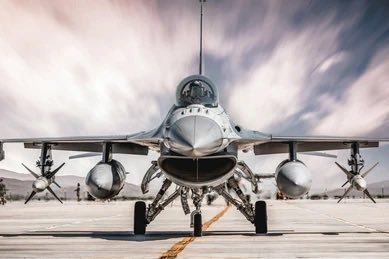
Washington has formally notified Congress of a proposed US$686 million upgrade package for Pakistan’s F-16 Fighting Falcon fleet — a move likely to significantly enhance its network-centric warfare capabilities.
What the Package Covers
- 92 tactical data-link terminals (Link-16), enabling secure, jam-resistant, real-time exchange of battlefield data among air, land, and sea forces — bringing Pakistan’s F-16s in line with modern interoperability standards used by the U.S. and NATO.
- Cryptographic modules and secure-communications hardware.
- Avionics upgrades, Operational Flight Program updates, and mission-planning systems.
- Identification-Friend-or-Foe (IFF) systems, training tools, simulators, and long-term logistical support. • Support to modernize and sustain Pakistan’s Block-52 and Mid-Life-Upgrade (MLU) F-16 fleet, extending operational viability through 2040.
The contract lists US$37 million as “Major Defence Equipment” and US$649 million for software, support, hardware updates, and logistics. Lockheed Martin is identified as the principal contractor for the defense-equipment components.
What Link-16 Means — Why This Upgrade Matters
Link-16 is a secure, time-division multiple access (TDMA) based tactical data-link protocol. It provides required functions for modern warfare: surveillance, identification, command and control, weapons coordination, air control, and electronic-warfare data distribution across all domains — air, sea, and land.
By equipping Pakistan’s F-16s with new Link-16 or compatible MIDS-LVT / MIDS-JTRS terminals, the jets become fully interoperable with U.S. and allied forces — allowing shared situational awareness, rapid data sharing, and secure communications, which are vital for combined operations, coalition deployments, or coordinated counterterrorism missions.
Upgraded avionics, secure-communications gear, and modern IFF further ensure that the jets meet the latest international security, electronic-warfare, and data-network standards — reducing risk and increasing operational flexibility.
Strategic Implications — What This Means for the Region
- Enhanced Interoperability with US & Allied Forces: With Link-16 and the upgraded secure comms, Pakistan’s F-16s can seamlessly communicate with US, NATO, and partner-force networks. This enables quicker, coordinated responses in multilateral operations or counterterrorism missions.
- Extended Fleet Life & Modernization: The upgrade ensures Pakistani Block-52 and MLU-series F-16s remain viable and mission-ready into the 2040s — a major overhaul of air-combat readiness for Pakistan.
- Significant Regional Impact: The move significantly raises the air-combat networking and data-link capabilities on the subcontinent — creating strategic pressure, particularly for regional rivals watching closely.
- Digital Battlespace Evolution: With modern data links and secure communications, Pakistan moves away from legacy air-combat tactics toward modern, network-enabled, sensor-fusion-driven operations.
What Comes Next
The $686M package now enters a 30-day Congressional review period, during which lawmakers can raise objections or request clarifications before final approval.
Given the presence of sophisticated systems like Link-16 in the transfer, and their strategic implications for South Asia, the deal could draw scrutiny in Washington and across New Delhi — especially from parties concerned with regional stability and balance of power.
Lockheed Martin, as principal contractor, is responsible for delivery; no additional U.S. personnel deployment is planned for Pakistan under the agreement, and U.S. defense readiness will not be impacted.
Conclusion — A Major Shift in Pakistan’s Air Combat Profile
With the planned delivery of 92 Link-16 tactical terminals and comprehensive avionics upgrades, Pakistan’s F-16 fleet is set for a dramatic modernization — one that elevates it into the realm of network-centric air forces, aligned with current NATO-level data-link standards. This isn’t a simple upgrade; it’s a structural evolution in capability, longevity, and strategic flexibility.
As the Congressional review progresses, global watchers — particularly in South Asia — will track this closely. For Pakistan, this package could define its air-power posture for decades to come.













